
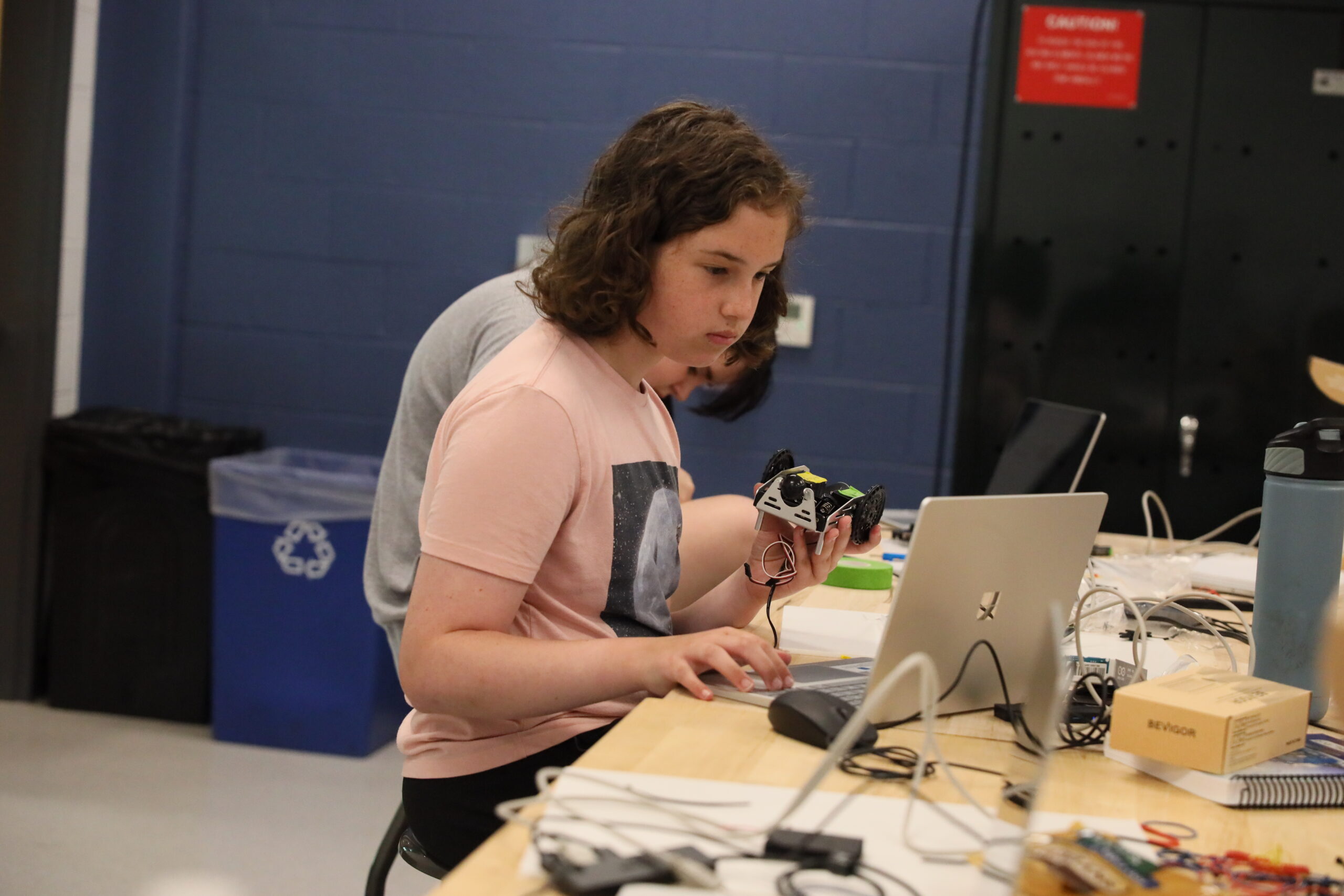
From June 23 to June 27, middle and high school students across the region spent the week at Shippensburg University to participate in the youth robotics camp. Led by Associate Professor of Computer Science and Engineering, João Dias, the program provided students with hands-on learning within robot design, programming and problem-solving using Arduino-powered ShieldBots — built using an Arduino board and a circuit board that plugs directly into the board, creating a functional design with advanced capabilities.
The camp is a collaboration between the university’s Office of Workforce Development and the Milton and Doreen Morgan School of Engineering, intended to help young students explore careers in science, technology, engineering and mathematics (STEM).
“Robotics is one of those key STEM-related fields that has been reshaping entire industries and will continue to experience growth through the next decades,” Dias said. “What inspired me to lead the Robotics Youth Summer Camp was the need to develop education programs here at Ship to teach students the basic principles of design, construction, operation and programming of robots. These are essential skills that will prepare students for the transformations robotics and automation are causing to the workplace.”
The program focused on ShieldBots controlled by an Arduino microcontroller, which is widely used in classrooms and labs across the nation. Each student was given an Arduino robotics kit to build and keep after the camp ended. Through an integration of lectures and labs, students learned how to build electronic circuits, write code and gain hands-on experience solving challenges with the robots.
“The ShieldBot controlled by Arduino microcontroller is one of the standard education kits widely used in robotics classes,” Dias explained. “It has a platform over which students can build simple electronic circuits to control the navigation of a wheeled robot. With this platform, students were assigned to design and program their robots for specific challenges.”
In one of the lessons, students learned how to program their robots to independently complete a maze without touching the lines. In another, they used whisker sensors and phototransistors to mimic the movement of a Roomba vacuum, allowing the ShielBot to move and respond to obstacles and light sources.
Dias designed the curriculum using material from the Carnegie Mellon Robotics Academy (CMRA), which he was able to access through his certifications in Robotics Integration and Software Foundations.
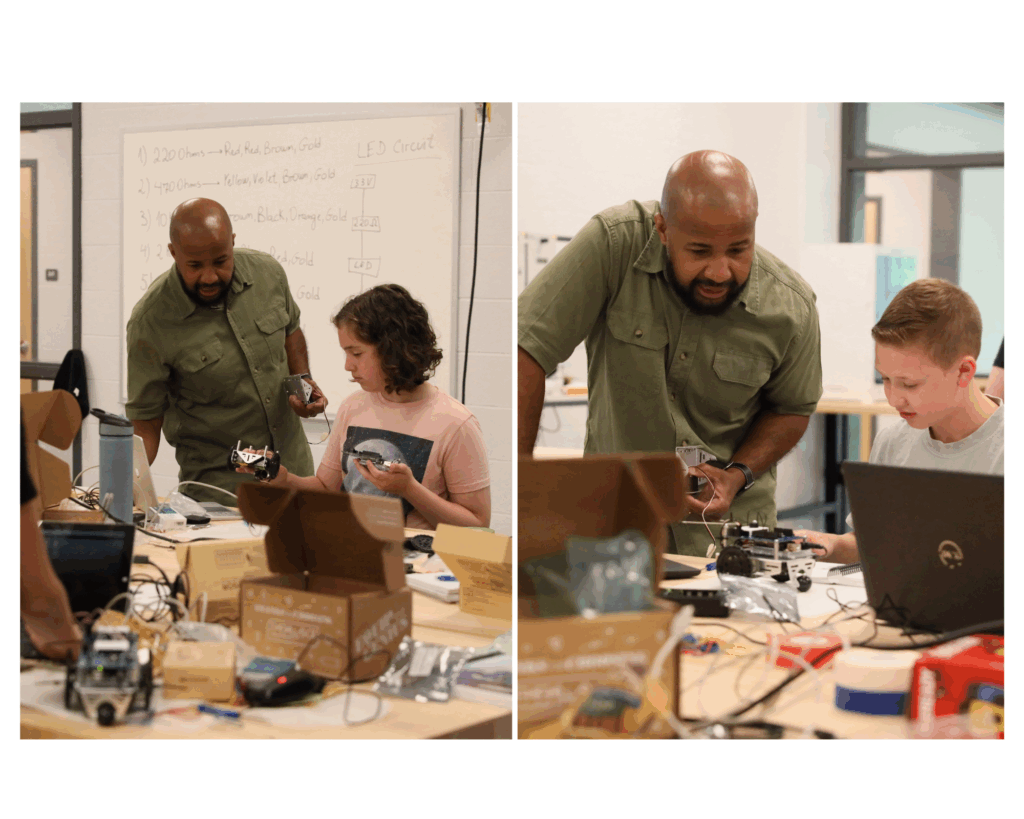
Not only did students get to engage in interactive lessons, they also spoke with professionals in the field. Guest speakers from Volvo and JLG gave presentations on how robotics are used in manufacturing today.
“Both presenters did an excellent job in capturing the attention the young students, and several questions were asked,” Dias said.
Students also participated in two off-campus field trips. They visited Scheiber Foods in Shippensburg and Ventura Foods in Chambersburg to see robots working on production lines.
The camp taught participants far more than just technical skills and about robotics, they also learned the power of strong communication, teamwork and at the same time learned how to solve complex problems independently.
“All hands-on activities proposed in the camp focused on developing students’ problem-solving and teamwork skills,” Dias said. “Since the construction and operation of robots involve the mechanical, electrical and programming elements, students were also taugh strategies to troubleshoot their robots by testing each of those elements separately.”
Dias and workforce development plan to offer the camp each summer and continue providing Arduino kits, daily lunch and field trips to all students ages 14 and up.
With the growing demand and interest in STEM, Ship’s robotics camp is helping to encourage young students interested in engineering and solving the complex technical problems of the future.
Learn more about Youth Summer Camps here.
