
Shippensburg University biology students Robert Long and Alissa Dorsey, and chemistry students Kate Tarbert and Landon Herzog, spent the summer of 2026 conducting research through Summer Undergraduate Research Experience (SURE) grants and Research Experiences for Undergraduates (REU) programs, supported by the SU Foundation.
“REU programs provide an excellent opportunity for our undergraduates to work in a graduate-level research lab and discover whether they want to pursue a graduate degree in the future, said Dr. Allison Predecki, chair and professor of chemistry and biochemistry. “REU programs in chemistry are highly competitive. We’re fortunate that our students are often selected for these experiences.”
The programs gave students the opportunity to work alongside faculty mentors, use advanced research equipment and explore graduate placements and career paths. Long, Dorsey and Tarbert shared their experiences and provided a glimpse into the research they conducted at their respective research sites.
Long participated in Yale University’s Physical and Engineering Biology REU funded by the National Science Foundation (NSF). This allowed him to work in a microbial ecology lab where he investigated bacteriophages (viruses that infect bacteria), using the “opportunistic pathogen” Pseudomonas aeruginosa as a model organism. Outside of the lab and presenting research, the program also involved graduate school preparation, career development and scientific communication workshops.
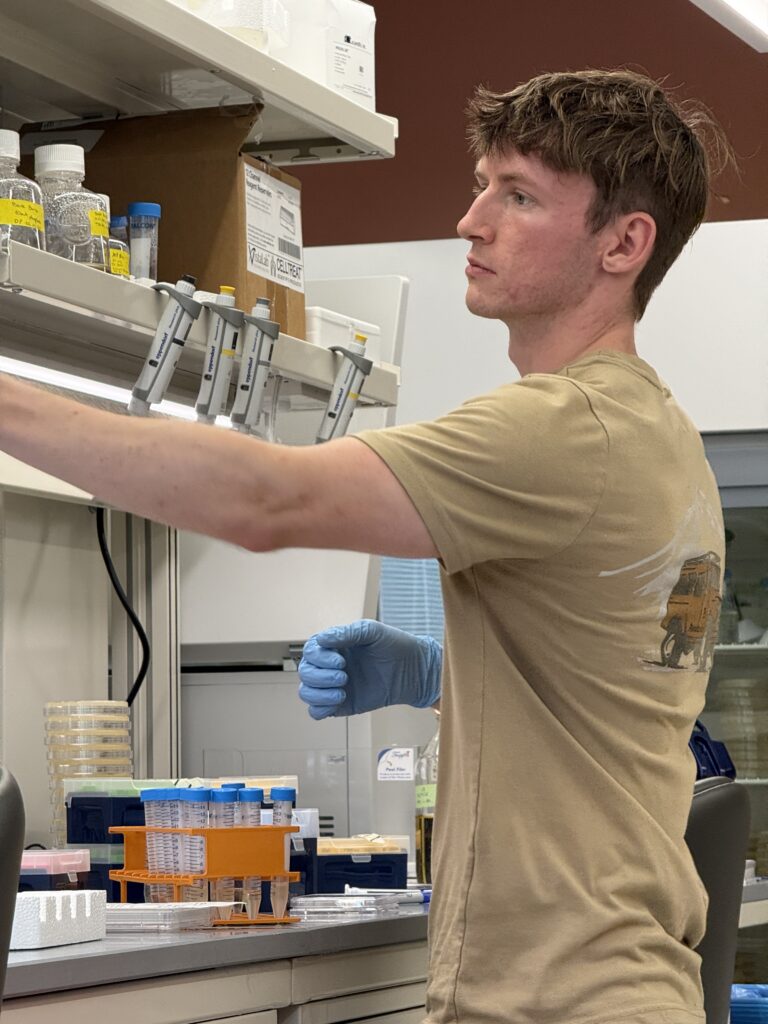
At the University of Nebraska-Lincoln, Dorsey conducted research for the university’s beneficial plant and insect REU program. Alongside her mentors Troy Anderson and Leslie Rault, she studied the types of yeast and fungi associated with mosquitoes in pollinator gardens.
The program included approximately 73 students representing areas such as biochemistry, agriculture, health and entomology. Dorsey also participated in outreach events, including activities that introduced elementary and middle school students to insects.
“I got to help my peers with teaching students about cockroaches and letting students pet them,” Dorsey shared.
Her experience was especially unique because she began her research at the University of Nebraska immediately after studying abroad in Australia. Instead of flying home to Pennsylvania, she flew straight to Nebraska.
At the end of the program, Dorsey and her peers presented posters describing their research at a symposium. Dorsey’s poster won first place in the Beneficial Plant and Insect group and first place overall.

As for Tarbert’s experience, she spent the summer completing research at the University of Southern Mississippi’s School of Polymer Science and Engineering. Her project, “Improving the Interfacial Welding of Multi-Material 3D Printed Parts via Expansion Annealing,” examined ways to improve the strength of parts made by multi-material 3D printing.
Her project involved designing and 3D-printing parts made from two different materials. Then, she applied a process called “expansion annealing” by submerging the parts in a solvent for a specified amount of time. The goal was to improve how well the two materials bonded at the point in which they met. After the annealing was complete, she tested if they stuck together better by using a tensile tester, which essentially pulled them apart until they broke.
From studying bacteriophages and fungi associated with mosquitoes to improving the strength of 3D-printed materials, students in biology and chemistry programs applied their knowledge to meaningful graduate-level research across the nation.
Through resources such as SURE grants and REU programs that are offered through Ship’s academic programs, students gain hands-on experience that prepares them for their futures.
To learn more about potential research opportunities, visit here:
https://www.ship.edu/academics/cas/chemistry/undergraduate_research/
