

Dr. Tim Hawkins, professor of geography and Earth science and student researcher, Grace Coffman, are continuing to lead research (funded by a grant from the Pennsylvania Department of Conservation and Natural Resources and the South Mountain Partnership) examining the environmental impact of warehouse development throughout the Cumberland Valley and its effect on air quality.
“We expected PM pollution to be higher in the valley due to the warehouse, highways, truck traffic and mountains that trap the pollution,” Hawkins said. The report conducted by the South Mountain Partnership found roughly 200 warehouses in the valley, a number that has risen since the first facility opened in 1988, and noted increased truck traffic on Interstate 81 and I-76 over the past 25 years.
Research from the Pennsylvania Department of Transportation (PennDOT), the Environmental Protection Agency (EPA) and other organizations measured fine particulate matter (known as PM2.5), using three independent methods: high-quality Environmental Protection sensors, lower-cost PurpleAir monitors and satellite observations. The findings showed the PM concentrations inside the valley were between 5% and 31% higher than outside, depending on the dataset and season. “We were surprised by how clear and strong the signal was in terms of differences between inside and outside the valley,” Hawkins said.
PM2.5 particles, at less than 2.5 micrometers in diameter, can penetrate deep into the lungs and enter the bloodstream. These particles are linked to premature death and complications in the cardiovascular and respiratory systems, the study notes. The report found that PM levels were the highest in the summer, followed by the winter and were the lowest in the spring and fall. Despite the valley’s elevated readings, overall PM concentration both inside and outside the valley has decreased over time. “We were pleasantly surprised to see the PM pollution both inside and outside the valley has decreased over the last 25 years due to regulations associated with the Clean Air Act,” said Hawkins.
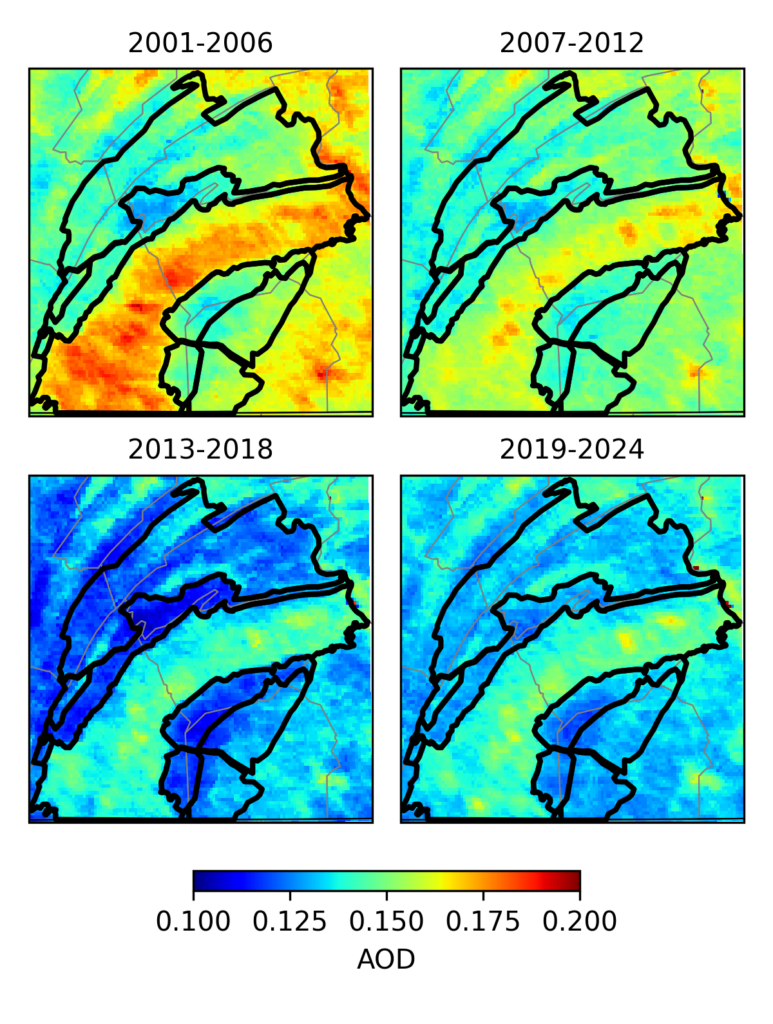
Researchers also applied EPA economic-emission models that connect industrial activity, in this case, warehousing, to specific PM emissions. Those model results, combined with the PM measurements, counts of warehouses and truck volumes, all contribute to the team’s conclusion that warehousing activity is a direct contributor to elevated PM2.5 in the valley.
The Cumberland Valley’s contribution to PM emissions is outsized relative to its footprint. The report reveals that the valley contributes more than five times the expected amount of PM emissions to Pennsylvania’s total and more than 10 times the expected contribution to national emissions. The team found that healthcare costs linked to pollution from warehousing in the valley are approximately 1% of the region’s warehousing sector GDP.
The report also showed a striking difference between economic growth and monetized health costs in recent years: while warehousing GDP rose, estimated health costs tied to PM levels fell by about 66% between 2014 and 2020, which Hawkins also attributed to the Clean Air Act. “Economic growth is occurring with less pollution, but it’s not zero pollution,” he said.
Short-term measures to reduce the community’s exposure are limited at the local level. Residents can reduce personal exposure by staying indoors on days with high PM level readings, especially during the peak of the summer and winter. To further reduce emissions, Hawkins urged continued legislative action at the state and federal levels and encouraged citizens to get involved. “Citizens can voice their support for these types of legislation. Citizens can also weigh in on the development of new warehouses in the region,” Hawkins noted.
The study also flagged data centers as a potential land-use issue. While similar to warehouses, data centers differ in operations, energy and water use and truck traffic. Researchers stated that their findings cannot be automatically applied to data centers, and further research is recommended.
Monitoring systems such as ground sensors and satellites continue to track conditions throughout the region. The study’s thorough research across multiple measurement platforms, emissions modeling and economic analysis provides a wide view of how concentrated industrial growth can influence air quality and public health, and suggests that regulatory progress has reduced (but not eliminated) the environmental cost of growth observed.
To read more, refer to the report by the South Mountain Partnership Conservative Network:
